

Introduction to Mixed Doubles Curling
Mixed doubles is a variation of traditional curling in which there are only two players per team—one female and one male. Mixed doubles was introduced as a World Championship event in 2008 in an attempt to convince the IOC to add an additional curling discipline to the Winter Olympics. (This was eventually successful in 2018.) I am painfully aware of this date as my wife and I lost the right to represent the United States on the last stone of the first U.S. Mixed Doubles National Championship game. (You can read about the match here.)
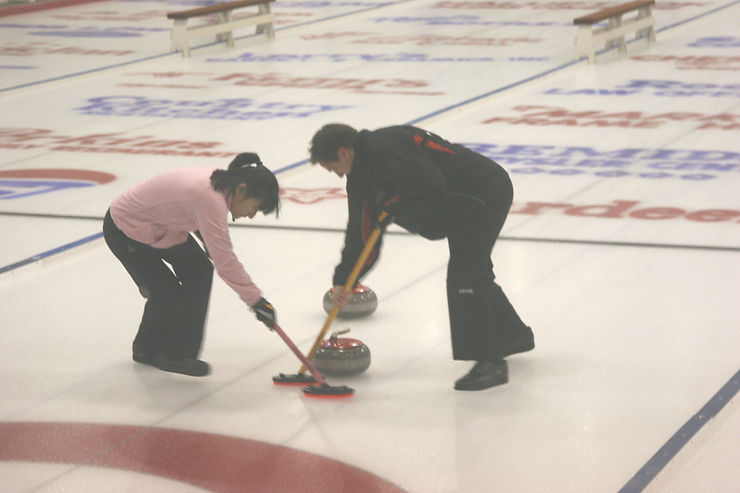
The scoring rules are the same as traditional four-person curling but the mixed doubles format is faster paced and often more exciting. In mixed doubles curling, only eight ends are played, and each team only throws five stones per end.
One player of a team throws the first and last (fifth) stones of an end, while the other player throws the second, third, and fourth stones. This order can change from end to end, which is not the case in four-person curling.
The other big difference from four-person curling is that two stones (one from each team) are pre-positioned in the playing area at the start of each end. Typically, the team that has the last stone of the end (i.e the hammer) has their sixth stone positioned behind the tee-line in the back of the four-foot circle (yellow stone B in the figure below). The team throwing first has a stone positioned as a guard on the center-line about halfway between the hogline and the house (red stone A is placed in one of six locations based on ice conditions.) These pre-positioned stones can count in the team’s final score for an end. Hence, the greatest score possible in an end of mixed doubles is six.

However, once per game, the team with the hammer can call a power-play. When this happens, the pre-positioned stones are moved to one side of the sheet instead of the center. This makes it more difficult for the team shooting first to steal the end because there are no center guards.

There are many subtleties to the discipline that can be explored in future posts. If you have specific questions, please send me an email. I can talk for hours about curling, but my goal is to help you understand the sport so that you can enjoy watching it.
More Information
I realized after writing this post that I used terminology that is probably not familiar to non-curlers. I am in the process of putting together a “Guide to Curling Terminology” that will be available to my newsletter subscribers within the next two weeks. Until then, if you would like additional information about the various types of equipment used in curling, from rocks and brooms to ice-making equipment and more, sign-up for my newsletter and I’ll send you my handout on “Curling Behind the Scenes for Newbies."
Good Curling!

Comments